The Real Reason You Keep Having the Same Fight With Different People
August 11, 2026
Every fight you’ve ever had with a partner, a coworker, a parent, or your own child has a pattern underneath it, and understanding Enneagram relationships is how you finally see it. Not a random pattern. A predictable one, tied directly to your type’s Existential Fear and what you do when that fear gets triggered.
Here’s the part most people miss about the Enneagram: your type isn’t just about you. It’s about what you build with other people, and what breaks down the moment fear takes the wheel instead of your Superpower.
How Fear Shapes Enneagram Relationships
Every type carries a Soul Desire, the kind of world they’re here to build with the people around them. A Type 1 wants fairness, a Type 2 wants devotion, and a Type 6 wants a community they can actually trust. When that desire is met, relationships feel easy, generous, alive. But every type also carries a fear. The moment that fear gets activated, the exact same gift that makes you good to be around turns into the thing that pushes people away.
Take a Type 8 and a Type 2 in a relationship, which is one of the more common pairings I see. The Type 8’s Superpower is seeing what needs to be done to build strong foundations. Their Soul Desire is collective stability. But their fear is being controlled or made powerless. When that fear spikes, they misuse their strength by controlling or dominating to avoid emotional disruption. Meanwhile, the Type 2’s Superpower is devoted attention that makes people feel uniquely seen. But their fear is being unwanted, and under stress, they offer care nobody asked for just to secure the connection. Put those two fears in the same room during a hard week. You get a Type 8 clamping down control while a Type 2 floods them with unrequested care. Both of them end up feeling exactly what they feared most: powerless, and unwanted.
This is not a compatibility problem. It’s a fear problem, and fear problems are workable once you can name them.
The Taboo Part Nobody Says Out Loud
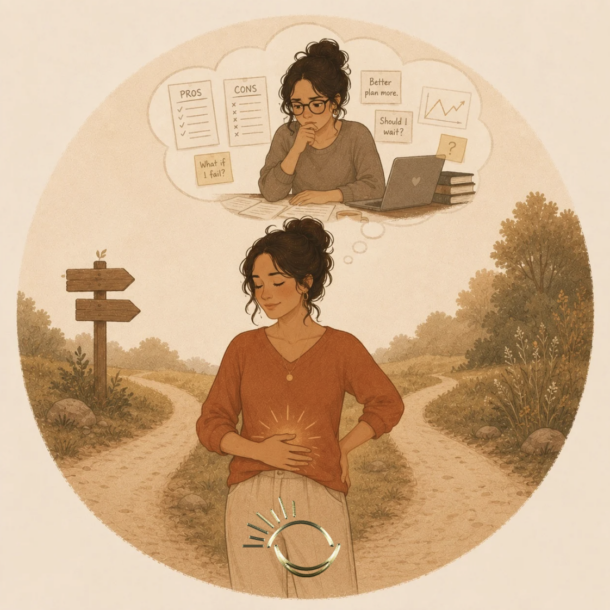
Now here’s the taboo part nobody says out loud. Most of the irritation and shame you feel in these moments has nothing to do with the other person at all. Even though it feels like it does. Shame and negative feelings only show up when you’re not meeting your own internal standard. That’s their entire job. They are not there to tell you what someone else did wrong. Instead, they are there to tell you that something inside you needs attention.
Your partner’s silence makes you spiral, your coworker’s tone makes you furious, or your child’s meltdown makes you feel like a failure. The instinct is to think the other person caused it. Now you feel like you need to be brave enough to confront them about it. But 99% of the time, what actually happened is an internal clash. Their behavior touched a standard you hold for yourself. The feeling that came up was never really information about them. It was information about you.
This changes everything about how you handle it. If you can catch the shame or the anger, ask quietly, “what standard of mine is this actually touching.” You can often shift the whole feeling internally. It happens without a single confrontation, without needing to gather the courage to state a boundary out loud. Not because confrontation is bad. It’s because most of what we call being triggered isn’t really about the other person’s behavior. It’s two internal worlds clashing in the same room, and only one of them is actually yours to manage.
How This Shows Up at Work and With Your Kids
The same dynamic happens at work. A Type 1 coworker whose fear is being wrong forces rules the moment they feel unheard. Meanwhile, a Type 9 colleague whose fear is being separate goes quiet and merges with whatever keeps the peace, even in disagreement. And it happens with your own children too, when a Type 4 child whose fear is having no identity overexpresses pain to feel significant, and a tired parent reads that as manipulation instead of fear.
Here’s what actually shifts these dynamics: naming the fear instead of reacting to the behavior, in yourself first. When you can say, even just internally, “this isn’t actually about me, this is their fear talking,” you stop taking the bait. When you catch your own fear the moment it activates, and ask what standard of yours got touched, you get a real choice. Instead of reacting from the Misused Superpower, you can respond from the Wisdom your type is capable of once the fear moves through.
That’s the part of the Enneagram that goes beyond “which type am I”. It’s not a personality quiz. It’s a map of how you love, how you fight, and how you can repair things internally before you ever need to say a word.
You can read more about the nine core motivations in the Enneagram Institute’s type descriptions.
See This Work in Real Time
If you want to understand exactly how your type shows up in your closest relationships, and what to do differently in the moment fear takes over, this is exactly the kind of work I do in 1:1 sessions. My free Enneagram e-book is also a good place to start.
This session should cost over 100€. I’m confident enough in what we can do together in 60 minutes that I’d stake that on it. But you don’t know me yet. And the coaching world has made it hard to know who to trust. So here’s my offer: 30€. One session. Let me show you what the Enneagram actually does when it’s used properly. If it doesn’t shift something real for you, then you lost 30€ and a lunch. If it does, and I believe it will, you’ll know exactly what to do next. Dare to take my hand? Book your 30€ session →